2 clinics — Goregaon West & Malad East, Mumbai Open Mon–Sat
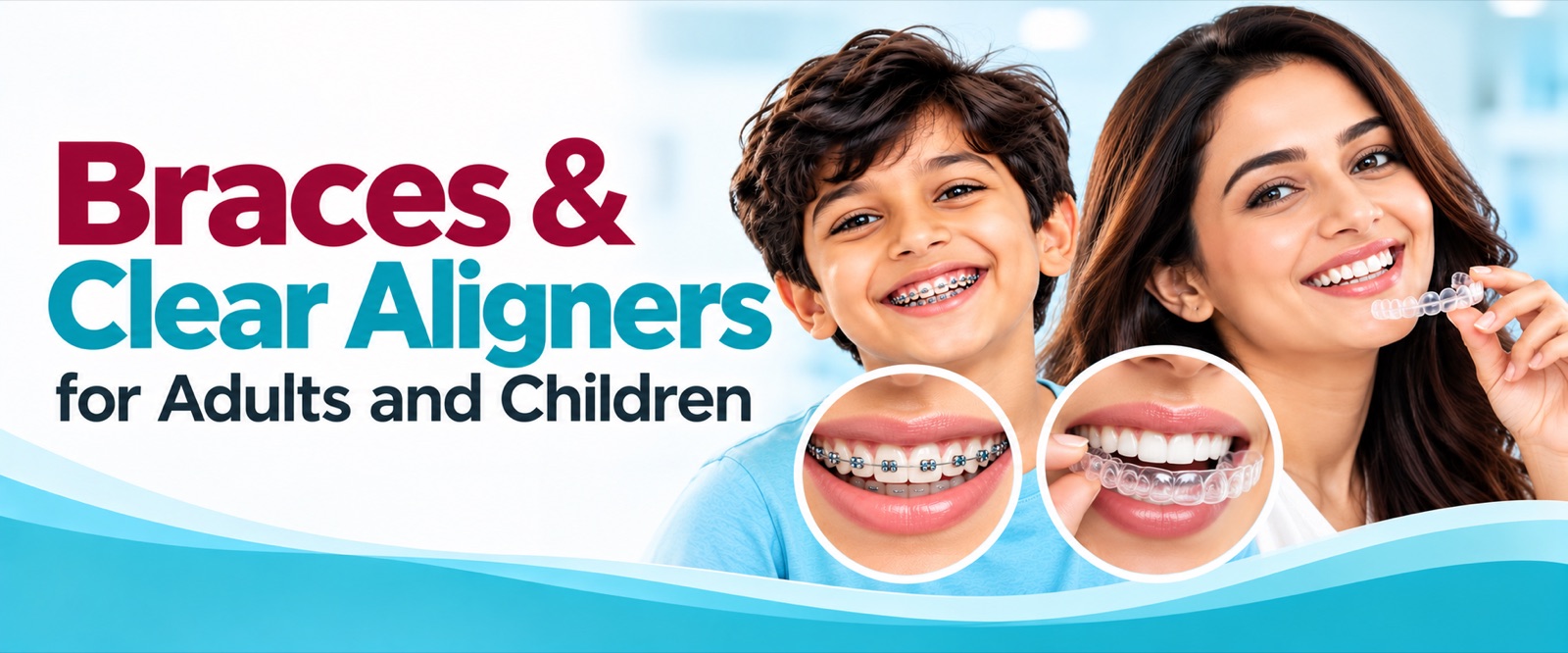
A boy wearing metal braces and a woman holding a clear aligner tray, with close-ups of both appliances
Teeth straightening

Straighter teeth with braces or aligners, Goregaon West & Malad East

Braces and clear aligners are orthodontic treatments that move teeth into better positions with light, steady pressure over many months. Braces are brackets and wires fixed to the teeth; aligners are removable clear trays. Both can help crowding, gaps and some bite problems in children, teenagers and adults whose gums are healthy.

★★★★★5.0 on Google from 124 patient reviews · Read what patients say

On this page

At a glance

Roughly one to three yearsDepends on the case and on following instructions
Visits every few weeksShort appointments, spaced as your plan requires
Metal, ceramic or clear alignersChosen after an examination, not before
Retainers come afterwardsTeeth drift if they are left out
Understanding it

About this treatment

Teeth move because the bone around each root slowly rebuilds itself under gentle, steady force. Brackets and wires apply that force from the front of the tooth. Aligners apply it by pressing against a series of slightly different trays. The biology is the same either way, so the real questions are practical. How visible do you want it to be, how much movement is needed, and will you really wear a tray for most of every day? A removable appliance only works while it is actually in your mouth.

Adults are often told they have missed the window. They haven't. Healthy teeth can be moved at almost any age as long as the gums and bone are in good shape, which is why a gum check comes before anything is stuck on. Children differ in a useful way: while the jaws are still growing, some problems can be guided rather than corrected later, and children's dentistry explains what an early check looks for. Dr. Mahesh will tell you if your case looks better suited to a specialist orthodontist, and will say so early.

Straightening has to fit around the rest of your mouth. A cavity, a tooth needing root canal treatment or a gum problem is dealt with first, and in a crowded mouth the plan may or may not involve a tooth extraction. If your real complaint is colour or a chipped edge rather than position, the options on cosmetic smile design may be all you need. If a better-looking smile is the only aim, ask whether straightening is needed at all; sometimes it isn't, and sometimes it is the gentlest route.

Reasons people ask about straightening

  • Crowded or overlapping teeth that trap food
  • Gaps between teeth that bother you
  • Upper front teeth that stick out
  • A bite where top and bottom teeth don't meet well, such as an overbite, underbite or crossbite
  • Teeth that look twisted or rotated
  • A child whose adult teeth are coming through out of line
Step by step

What treatment involves, start to finish

Examination and records

Dr. Mahesh checks your teeth, gums and bite, usually with X-rays and photographs, and asks what you want to change and what worries you. Cavities and gum problems are treated before anything is fitted. Bring any old dental reports or X-rays you have; they save repeat work. Nothing starts until you have agreed the plan, and you can ask for time to think it over.

The plan and the choices

You are told which appliance suits your teeth, whether any extraction is likely to be advised, roughly how long it may take and what it will ask of you each day. Ask anything you like, including about getting a second opinion before you begin. Nobody should start straightening without understanding the plan and what they will be asked to do at home.

Fitting

Braces are bonded to the teeth, usually in a single longer sitting. For aligners, you are given the first trays along with instructions on how to wear and clean them. Expect tight, tender teeth for the first few days while you get used to the feel. Soft food helps, and the soreness eases as the days go on. Keep wax handy for any bracket that rubs your cheek.

Adjustment visits

Every few weeks the wire is changed or elastics are replaced, or you move on to the next trays, and progress is checked against the plan. If a bracket breaks, a wire pokes or a tray cracks, call us rather than waiting for the next visit; delays can add time. Keep appointments even if everything seems to be going well.

Braces off, retainers on

When the teeth reach their planned positions, the braces are taken off and a retainer holds them there. Expect the teeth to feel smooth and slightly odd for a few days. You will be told how long to wear it and when to come back for a check. This is the stage people most often neglect, and the one they most often regret neglecting.

Your choices

Straightening options

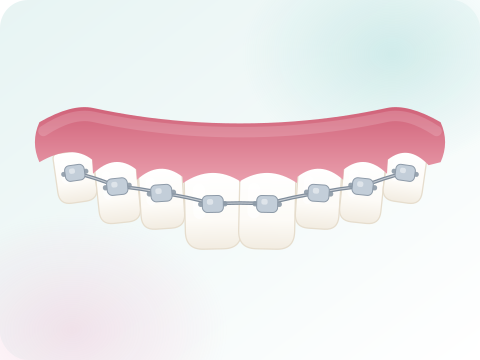
Illustration of metal braces: brackets bonded to each tooth joined by an archwireFixed, most versatile

Metal braces

Steel brackets bonded to each tooth and joined by a wire. They suit the widest range of cases, including complicated tooth movements, and they work whether or not you remember to do anything. Their visibility is the usual reason people choose another option.

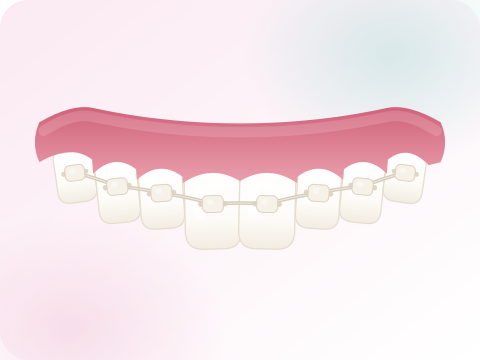
Illustration of ceramic braces with tooth-coloured brackets that blend with the teethFixed, tooth-coloured

Ceramic braces

Brackets made in a tooth-coloured or clear material, so they draw less attention at conversation distance. Some are a little bulkier than metal, and the small elastic ties can pick up colour from tea and curry, so cleaning has to be thorough.

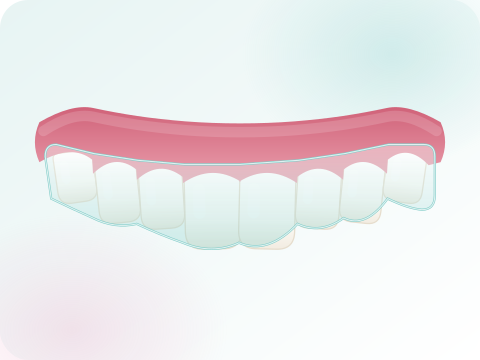
Illustration of a transparent clear aligner tray fitted over the upper teethRemovable trays

Clear aligners

A set of transparent trays, each moving the teeth a little further. They come out for meals and brushing. Most systems expect you to wear them for about twenty to twenty-two hours a day, and they should be planned and checked by a dentist who has examined you.

Illustration of a child's teeth with a baby-tooth gap and a simple orthodontic applianceGuiding growing jaws

Child orthodontics

Simple appliances used while a child's jaws are still developing, for particular problems such as a narrow arch or a habit affecting the bite. Many children need nothing more than watching. Dr. Mahesh will say whether to act now or review later.

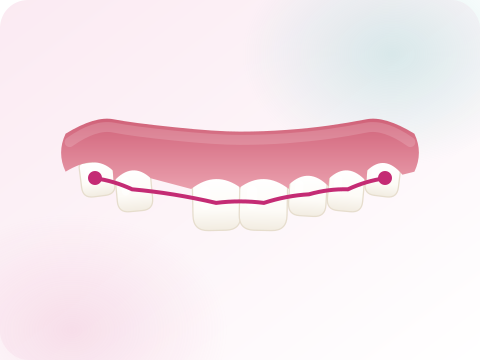
Illustration of a retainer with a wire bow across the front teethAfter every course

Retainers

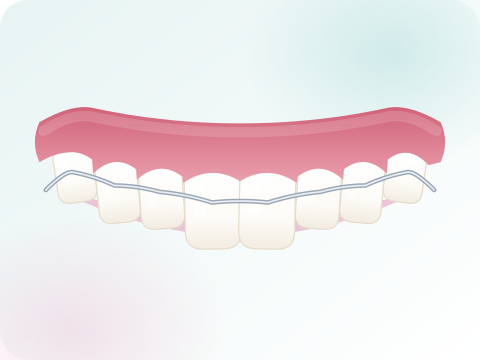
A thin wire fixed behind the teeth, a removable clear tray, or a plastic and wire plate. Which one you get depends on your case. Wear it exactly as told, because without it the teeth tend to slide back towards where they started.

Plan for keeping teeth straight as well as getting them straight.Ask at the start whether retainers and follow-up visits are part of the plan, and how long you will be expected to wear them. Teeth can drift for years after treatment if retainers are left out, so this is worth settling before you begin.
Straight answers

Braces and aligners: what people get wrong

Myth

Braces always mean pulling teeth out.

Fact

Fact: Many cases don't need extractions. It depends on how crowded the teeth are, how far the front teeth stick out and how much space there is. When removal is advised it is planned from X-rays and explained to you in advance, and some cases have a route without it.

Myth

Aligners are quicker and work for everyone.

Fact

Fact: Aligners suit many mild to moderate cases but not every bite or every twisted tooth, and they depend on you wearing them. Neither option is faster as a rule. Your teeth, not the brochure, decide which one is realistic.

Myth

Retainers are only needed for a year.

Fact

Fact: How long you wear a retainer is decided by your dentist and is often long term, because teeth drift as you age. Following that advice is part of the treatment, not an optional extra added on the end.

Living with braces or aligners

  • Teeth are sore for a few days after fitting or an adjustment. Dal, khichdi, curd rice and idli are easy to chew, and an ordinary painkiller used as the label says helps.
  • Brush after meals and clean around the brackets with a small interdental brush.
  • With fixed braces, steer clear of chewing gum, popcorn, hard chikki and sticky toffee, and cut apples and corn rather than biting into them. Chewing nails or pens damages brackets.
  • Take aligners out to eat and to drink anything but plain water. Brush before putting them back, and keep them in their case, never in a tissue.
  • Wear elastics, if given any, as told; skipped days slow things down.
  • If a wire pokes or a bracket comes loose, cover it with orthodontic wax and call. Don't snip or pull at it yourself.
  • If a retainer stops fitting after a gap, bring it in; forcing it on can do harm.
Visit us

Braces and aligners near Goregaon West and Malad East

Straightening means many short visits over a year or more, so an easy-to-reach clinic matters. Goregaon West, at 8/60, Navjyoti Society Road, off Mahatma Gandhi Road in Unnat Nagar 2, is open Monday to Saturday, 10 AM to 4 PM, and is easy to reach from Jogeshwari and Bangur Nagar. The Malad East clinic, at Shop No. A/4, Sunshine Co-op Housing Society, Subhash Lane, Shivaji Nagar, runs 6 to 9 PM on the same days, which tends to suit office-goers and students after classes.

For a first visit, bring any earlier dental X-rays or photographs, a list of the medicines you take, and any old retainer or aligners if you are switching from another clinic. Call, or message us on WhatsApp, to pick a slot at either clinic. Walk-ins are welcome, but booking avoids a wait, and an unhurried first visit is worth having. If you are comparing clinics, ask for the plan in writing.

Goregaon WestMain clinic

8/60, Navjyoti Society Rd, off Mahatma Gandhi Road, Unnat Nagar 2, Goregaon West, Mumbai 400104

Mon–Sat · 10:00 AM – 4:00 PM

Get directions →

Malad EastEvening clinic

Shop No. A/4, Sunshine Co-operative Housing Society, Subhash Lane, Shri. B. L. Murarka Marg, Shivaji Nagar, Malad East, Mumbai 400097

Mon–Sat · 6:00 PM – 9:00 PM

Get directions →
Good to know

Braces & Aligners: questions patients ask

Choosing between braces and aligners

Are braces or aligners better? +
Neither is better for everyone. Aligners are removable and discreet, and they suit many mild to moderate cases of crowding or spacing. Fixed braces handle twisted teeth and more demanding bite corrections more predictably, and they work without your help. Aligners rely on you wearing them for most of the day. Dr. Mahesh will examine your teeth and tell you which is realistic, then talk through the trade-offs.
Do aligners work for every case, and who should plan them? +
No. Some bite problems, rotated teeth or larger movements are better handled with fixed braces or a combination. Aligners should be planned and monitored by a dentist who has examined your mouth, ideally with X-rays first. Before starting anywhere, ask what happens if a tray doesn't fit, whether refinements and retainers are included, and who you see if something goes wrong. Be wary of any plan where nobody examined you in person.
Can adults get braces, and is there an age limit? +
Yes, adults can have braces or aligners, and there is no fixed age limit. What matters is healthy gums and enough bone around the teeth, so a gum check comes first. Adults often choose ceramic braces or aligners because they look less obvious at work. Treatment may take a little longer than in a teenager, and retainers matter even more afterwards. Existing crowns or fillings can affect how brackets are placed.
What are invisible braces? Are ceramic braces the same as aligners? +
People use invisible braces for several things, so check what is meant. Most often it means clear aligners, which are removable trays. It can also mean ceramic braces, which are fixed brackets in a tooth-coloured material, or braces fitted on the back of the teeth. Ceramic brackets are less noticeable than metal ones but still visible up close. Ask how visible each would be on your teeth.
Do I need teeth taken out for braces? +
Not always. It depends on how crowded your teeth are, how far the front teeth stick out and how much space is available. Some cases are treated without removing any teeth. When extractions are advised, they are usually of small teeth at the side of the mouth, done under local anaesthetic, and planned from your X-rays. Dr. Mahesh will explain why before anything is decided, and you can ask for a second view.

During treatment

Do braces hurt, and for how many days? +
Fitting braces isn't painful, but the teeth feel tight and tender a few hours later, and this can last several days. It tends to return, more mildly, after adjustments. Soft food and an ordinary painkiller taken as per the label usually cope with it. Cheeks and lips may be sore for a week or two until they toughen. If pain goes on beyond a few days, or a wire or bracket is digging in, call us.
I feel no pressure since getting braces. Are they working? +
Quite possibly. People differ widely in how much they feel, and teeth can move with little discomfort. Progress is judged by how the teeth have shifted at your appointments, not by the ache. If nothing seems to be changing at all after several visits, say so at the next one and Dr. Mahesh will check the wires, elastics and your plan.
How long will braces take? +
Most courses run somewhere between one and three years, but yours depends on how crowded or misaligned the teeth are, your age, and how closely you follow instructions. Missed visits, broken brackets and skipped elastics all add months. Dr. Mahesh will give you an estimate after examining your teeth, and will tell you if it changes along the way.
How many hours a day must aligners be worn, and can I eat normally? +
Most systems expect around twenty to twenty-two hours a day, but your dentist's instructions are the ones to follow. You take the trays out to eat and drink, so there are fewer food rules than with fixed braces. Brush before putting them back, or food gets trapped against the teeth. Keep them in their case at meals. Leaving them out for long stretches stalls progress.
What foods should I avoid with braces? +
Anything hard, sticky or very chewy can break brackets or bend wires: popcorn, hard chikki, toffee, chewing gum, whole apples and cucumber, and corn bitten off the cob. Cut food into small pieces instead. Sugary snacks and drinks matter too, because plaque collects around brackets and can leave marks on the teeth. Ask for the full list at your fitting visit.

After the braces come off

How long do I have to wear a retainer, and is it for life? +
Your dentist decides, but the honest answer is often long term. A common pattern is wearing it most of the day for the first months, then at night only, and for some people a fine wire bonded behind the front teeth stays in for years. Teeth keep drifting slightly as we age, so a retainer is what protects the result you worked for. Don't stop on your own.
I stopped wearing my retainer and my teeth have moved. What now? +
Come in and have your teeth looked at; don't try to force the old retainer on. A small shift may be corrected with a new retainer or a short course of aligners, while a larger change may need braces again. Dr. Mahesh will check how much has moved and what is realistic. If your old retainer hurts or no longer fits, that is a sign the teeth have moved.
Can I have my braces removed early for a wedding or exam? +
It is better not to. Taking braces off before the teeth have finished moving can leave them in a half-corrected position, and they may drift back. Never remove brackets yourself. If you have an event, tell us as early as possible and Dr. Mahesh can say whether the timing can be worked around, or whether the finish date is already close enough.

Children, cost and insurance

At what age should a child get braces? +
There is no single age. Many children who need braces start somewhere between about eight and fourteen, depending on how their teeth and jaws are growing. A check in the early school years is reasonable if you see crooked teeth, upper front teeth sticking out, or a bite that looks off, and often the advice is simply to watch. See also dentistry for children. Dr. Mahesh will tell you whether to act now or review in a year.
How much do braces or aligners cost in Mumbai? +
It depends on your case, so a figure given without an examination would be a guess. What shapes the cost: the type of appliance, how complex the movement is, how long treatment is likely to run, whether extractions or extra appliances are needed, how many visits, and whether retainers are included. After examining you, Dr. Mahesh explains the options and what each involves. Call or message us on WhatsApp to arrange that visit.
Is braces treatment covered by health insurance? +
Often not. Braces and aligners are usually treated as elective or cosmetic, and many policies exclude them, though some cover dental treatment only after an accident or if you are admitted to hospital. Read your policy for outpatient dental cover, waiting periods and exclusions, or ask your insurer. We can give you a written estimate and records for your paperwork, but we can't say what your plan will pay.
Related treatments

You may also want to read

Find out which straightening option suits your teeth

Call or message us to book an examination at Goregaon West or Malad East. Dr. Mahesh will explain your options before you decide anything.

Call Now WhatsApp