2 clinics — Goregaon West & Malad East, Mumbai Open Mon–Sat
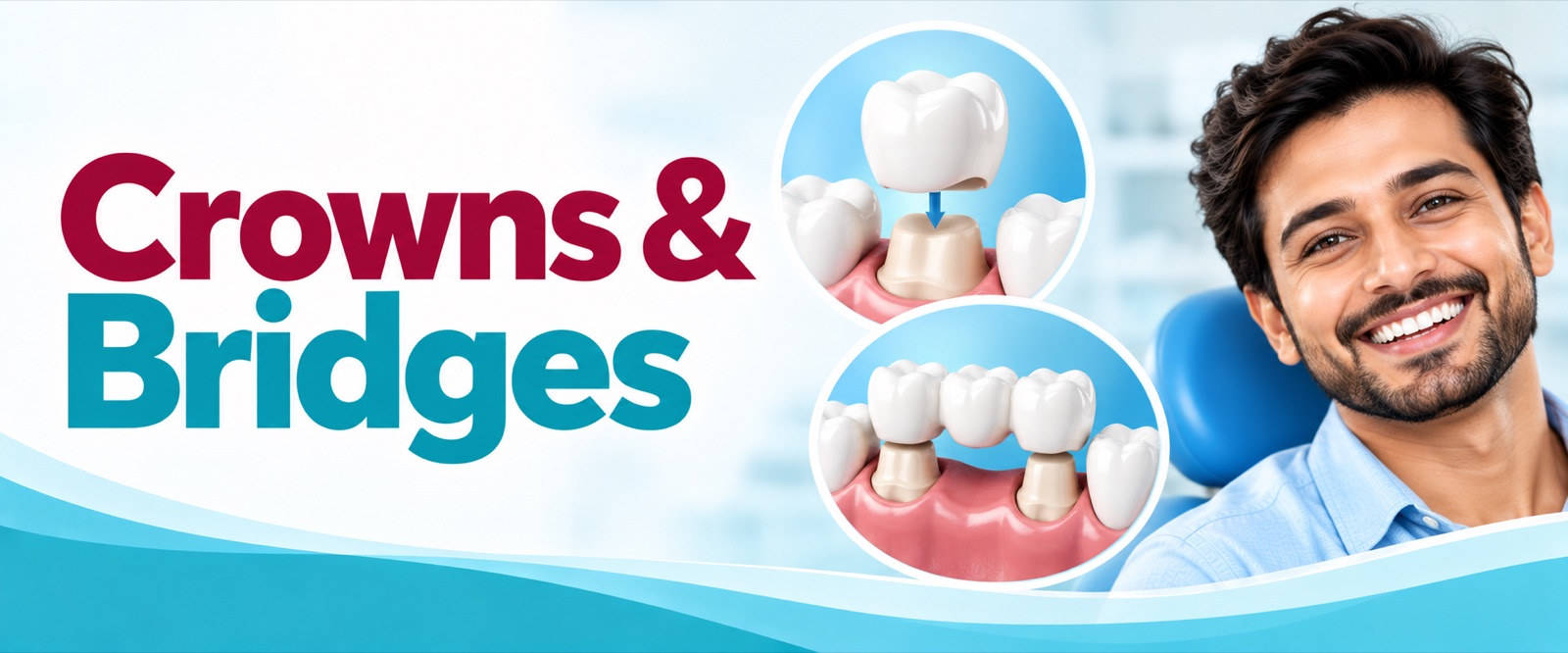
Smiling man in a dental chair beside illustrations of a dental crown being fitted and a three-unit bridge
Repair and replace

Tooth caps and bridges in Goregaon West & Malad East

A dental crown is a tooth-shaped cover, made in a laboratory, that fits over a damaged tooth to restore its shape, strength and bite. A bridge is a fixed row of teeth that fills a gap by anchoring to crowns on the teeth either side. Together they help people with cracked, root-treated or worn teeth, or a missing tooth with healthy neighbours.

★★★★★5.0 on Google from 124 patient reviews · Read what patients say

On this page

At a glance

Usually two visitsShaping the tooth, then fitting the crown
Made to orderA laboratory crafts it between visits
Numbed firstShaping is normally done under local anaesthetic
Often 5 to 15 yearsDepends on material, bite and cleaning
Understanding it

About this treatment

Think of a crown as a thimble for a tooth. When a tooth has lost too much of itself, to a large cavity, a crack or years of grinding, a filling can't hold the remaining walls together, and they flex every time you chew. A crown fits over everything above the gum and takes that load instead. It isn't the answer to every damaged tooth, though. Dr. Mahesh looks at how much healthy tooth is left first, and if a filling would last, he'll tell you so and explain what it would and wouldn't hold up to.

Teeth that have been through root canal treatment are among the most common candidates. With the nerve removed and an opening drilled through the top, a back tooth in particular can turn brittle, so a crown is usually advised to protect it. A front tooth with plenty of structure left may manage without one. Cracked cusps, worn-down teeth and old fillings that keep breaking are the other usual reasons. The call comes from the X-ray and the tooth itself, not a fixed rule, and it's fair to ask for the reasoning.

A bridge solves a different problem, which is a gap. Crowns on the two teeth beside the space hold a replacement tooth in between, and the whole unit is cemented in, so nothing comes out at night. The catch is that the neighbours have to be shaved down to carry their crowns, even when they're perfectly healthy. A dental implant avoids that but needs enough bone and a longer wait, and a removable partial denture (see dentures) avoids cutting teeth altogether. Each has a place, and Dr. Mahesh will weigh them against your actual gap.

When a crown or bridge comes up

  • A back tooth after a root canal, with only a thin shell left
  • A crack through a tooth, sometimes felt as a twinge on biting
  • A big old filling that keeps breaking
  • Teeth ground flat or worn short
  • A gap where a tooth was removed, with healthy teeth either side
  • An existing crown that is loose, chipped or shows a dark line at the gum
Step by step

From first visit to final fitting

Examination and X-ray

Dr. Mahesh looks at the tooth, takes an X-ray and checks your gum and bite. This is the moment for awkward questions: could a filling do, and what does each material mean for how the tooth looks? Infection or deep decay is dealt with first, which can mean root canal treatment before any crown work begins. You leave knowing what's recommended and why.

Choosing material and shade

You and Dr. Mahesh settle on a material, keeping in mind where the tooth sits, how hard you bite and if you grind at night. For a front tooth the colour matters most; for a back molar, strength does. Matching one tooth to its neighbours is the fiddly part, so say plainly if the shade looks off when you see it.

Shaping the tooth

The tooth is numbed, then trimmed all round so a crown can slip over it without feeling bulky. Decay or an old filling is cleared away and, if too little tooth remains, it's built up first. Most people feel pressure and vibration but no pain, and if you feel a sharp twinge, tell us straight away so more numbing can be given. For a bridge, both neighbouring teeth are shaped in the same sitting.

Impression and temporary

An impression records the shaped tooth and the teeth around it, and goes to the laboratory. Meanwhile you wear a temporary, usually plastic, to protect the tooth. It's short-term by design, so chew on the other side, skip sticky sweets, and slide floss out sideways rather than pulling it up. If it comes off, call the clinic, because the tooth underneath is exposed.

Fitting and bite check

At the second visit the temporary comes off and the crown is tried in before anything is cemented. You look at the colour and shape, and Dr. Mahesh checks how your teeth meet. A crown a fraction too high makes the tooth ache on biting, so speak up if anything feels wrong. Once you're both happy it's cemented, and brief sensitivity to hot and cold is common.

Your choices

Crown materials and bridges

Toughest, least tooth removed

Metal and porcelain-fused-to-metal

Metal alloys are very durable and need less shaping, but they look like metal, so they tend to suit far back molars. Porcelain-fused-to-metal adds a tooth-coloured layer, though that porcelain may chip and a dark line can show at the gum.

Very hard, metal-free

Zirconia

A strong ceramic, often chosen for back teeth because it copes well with heavy biting and is kind to the opposing tooth. Some versions carry a porcelain layer, and that layer can chip. No crown is unbreakable, so Dr. Mahesh won't promise one.

Closest to natural enamel

All-ceramic or pressed ceramic

Lets light through much as enamel does, so it suits front teeth and people with a metal allergy. It can be less resistant to heavy biting than zirconia, so it is weighed against how you chew and if you grind.

Replaces one or more teeth

Fixed bridge

Crowns on the teeth either side carry the false tooth between them. It's cemented, so it stays put, but the supporting teeth have been shaped, and the area underneath needs a threader or small interdental brush daily. Dr. Mahesh checks the supporting teeth are strong enough first.

There's no single best crown material.It depends on which tooth it is, how hard you bite, any grinding at night and how healthy your gums are. Dr. Mahesh will explain why he's leaning one way, and you can ask about the downsides of the others.
Straight answers

Crown myths worth dropping

Myth

Zirconia is unbreakable.

Fact

Fact: It's very strong, but not indestructible. Porcelain layered over a zirconia core can chip, and heavy grinding stresses any crown. If you clench at night, mention it before the material is chosen, since a night guard may be worth considering.

Myth

A crowned tooth can't get cavities.

Fact

Fact: The crown itself can't decay, but the tooth underneath can, mostly where the crown meets the gum. Brushing and flossing to that line matter as much as before. A bad taste, smell or pain around a crowned tooth deserves a check.

Myth

Metal crowns are outdated.

Fact

Fact: They remain among the most durable options and need less of your tooth removed. Appearance and metal allergy are the main reasons people choose ceramic instead. On a far back molar, metal can be a sensible choice.

Looking after a crown or bridge

  • Expect touchiness with very hot or cold drinks for a couple of weeks; a scalding cup of chai is the usual culprit.
  • Brush right up to the gumline where the crown ends, since that edge is where decay likes to start.
  • Thread floss under a bridge daily with a floss threader or small interdental brush.
  • Don't use crowned teeth to crack ice, split supari or tear open packets.
  • If the bite feels high, or the tooth hurts on biting after fitting, book a quick adjustment instead of getting used to it.
  • If a crown comes loose, keep it safe, don't glue it back with anything from the kitchen drawer, and call us the same day if you can.
  • Keep up six-monthly teeth cleaning visits so the edges around crowns get checked.
Visit us

Crowns and bridges near Unnat Nagar and Shivaji Nagar

If you're in Goregaon West, the main clinic is at 8/60, Navjyoti Society Road, off Mahatma Gandhi Road in Unnat Nagar 2, open Monday to Saturday, 10 AM to 4 PM. Crown work needs two visits, so pick two days you can manage and mention any deadline, such as a wedding or trip, when you book. It's easy to reach from Goregaon East and Jogeshwari. Walk-ins are welcome, and a booked slot avoids waiting.

In Malad East, the evening clinic runs Monday to Saturday, 6 PM to 9 PM, at Shop No. A/4, Sunshine Co-op Housing Society, Subhash Lane, B. L. Murarka Marg, Shivaji Nagar. It suits you if you'd rather not take time off work for the fitting. Call or message us on WhatsApp to book; walk-ins are welcome, though a booked slot avoids the wait. Bring any X-rays of the tooth and a list of your medicines, and if a crown has come off, bring it in a clean container.

Goregaon WestMain clinic

8/60, Navjyoti Society Rd, off Mahatma Gandhi Road, Unnat Nagar 2, Goregaon West, Mumbai 400104

Mon–Sat · 10:00 AM – 4:00 PM

Get directions →

Malad EastEvening clinic

Shop No. A/4, Sunshine Co-operative Housing Society, Subhash Lane, Shri. B. L. Murarka Marg, Shivaji Nagar, Malad East, Mumbai 400097

Mon–Sat · 6:00 PM – 9:00 PM

Get directions →
Good to know

Crowns & Bridges: questions patients ask

Choosing a crown

How long do dental crowns last? +
Usually somewhere between 5 and 15 years, and sometimes longer. What decides it is mostly everyday habits: how well you clean to the gumline, any grinding, and what you bite on. Decay at the crown's edge is a common reason they're replaced. A crown that has served for ten years isn't failing, while one that's loose or sore after three needs a look sooner rather than later.
Which is better, a zirconia or a ceramic crown? +
Neither wins everywhere. Zirconia is very hard and is often chosen for back teeth that take heavy biting. Ceramic that lets light through looks closest to natural enamel, so it often suits a front tooth. Both can chip in the wrong situation. Dr. Mahesh will decide with you by looking at where the tooth sits, how you bite and any grinding, not by a blanket rule.
Do I really need a crown, or can I just get a filling? +
It depends on how much healthy tooth is left. If the walls are still solid, a filling is the gentler option and Dr. Mahesh will say so. A crown makes sense when a tooth is cracked, or so broken down that a filling would have little to hold on to. You're welcome to ask to see the X-ray, have the reasoning explained, and take a second opinion if you want one.
Is a cap compulsory after a root canal, and how soon does it go on? +
Not on every tooth, but most back teeth that have had a root canal are advised to get one, because a treated tooth is more brittle and can split. A front tooth with plenty of healthy structure sometimes manages with a filling. Usually a temporary filling goes in first and the crown follows at a later visit once the tooth has settled, so go easy on that side until then.

Bridges, implants and missing teeth

Is it better to get a bridge or an implant? +
It depends on your bone, the neighbouring teeth and how long you're willing to wait. An implant replaces the root, protects the jawbone and leaves neighbouring teeth untouched, but it needs enough bone, surgery and months of healing. A bridge is quicker and has no surgery, but the teeth beside the gap are shaped and take extra load. Our dental implants page explains that route, and Dr. Mahesh can compare both for your gap.
Do the teeth next to the gap have to be filed down for a bridge? +
For a traditional bridge, yes: the two teeth beside the gap are shaved so crowns can fit over them. That's the main drawback, especially when those teeth are healthy. Some front-tooth gaps can be filled with a bonded bridge that needs far less shaping, though it isn't suitable everywhere. If cutting healthy teeth bothers you, say so, because it's a fair reason to compare with an implant.
Can I eat normally with a bridge? +
Yes, once it's fitted and the bite feels comfortable. Avoid chewing ice or very hard things, as with any crown work. What people underestimate is the cleaning: food and plaque collect under the false tooth, and decay in the supporting teeth is a common reason bridges fail. A floss threader or small interdental brush used once a day is what keeps one going.
How long can I leave a missing tooth before it matters? +
There's no fixed deadline, but waiting for years can have a cost. Neighbouring teeth may tilt into the space, the tooth opposite can drift downwards, and the bone where the tooth was slowly shrinks, which can make a bridge or implant harder later. If you're not ready, get the gap assessed and ask how urgent yours is. If the tooth is still in your mouth but failing, see tooth extraction.

During and after treatment

Does getting a crown fitted hurt? +
Usually not, because the tooth is numbed before it's shaped. You'll feel pressure and vibration, and the injection itself is brief. Afterwards the tooth and gum can feel tender, or sensitive to hot and cold, for a short while, sometimes a couple of weeks. A tooth that has had a root canal has no nerve left to ache, though the gum around it can still be tender.
Why does my crown hurt when I bite down? +
Often because the crown sits a touch too high and takes the bite before the other teeth do, which is a quick fix at the clinic. Other causes include an inflamed tooth nerve, a crack, or decay at the edge, so it needs a check rather than waiting. Some sensitivity for a couple of weeks after fitting is normal, but pain on biting that carries on, or that wakes you at night, deserves a call.
What should I do if my crown comes loose or falls off? +
Keep it somewhere safe, clean it gently and call the clinic as soon as you can. Don't glue it back with household adhesive, which can damage the tooth and stop the crown seating properly. The exposed tooth may be sensitive and can chip, so avoid chewing on it. Bring the crown along: sometimes it can be re-cemented, and sometimes the tooth underneath has decayed and it no longer fits.
Can I travel or go to work with a temporary crown? +
Yes, for short periods, but it's weak by design. Temporary crowns are usually plastic and meant to last only until the real one arrives, so avoid chewy, sticky and hard food and floss carefully. If you have a trip coming, tell us at the first visit so the appointments can be planned around it. If the temporary comes off, call the clinic rather than waiting until you're home.

Cost and timing

What decides the cost of a crown or bridge? +
The number of teeth involved, the material, the laboratory work and whether the teeth need other treatment first, such as a root canal or gum care, all change the cost. A bridge is more than one crown, so it involves more work. We can only give a fair estimate after Dr. Mahesh has examined you, so call or message us on WhatsApp to book that.
How many visits does a crown take, and how long is the wait? +
Usually two visits: one to shape the tooth and take the impression, and one to fit the finished crown. In between, the laboratory needs time to make it, often two to three weeks and sometimes longer. If you have a date to meet, say so at the first visit. Any root canal or gum treatment needed beforehand adds to the number of visits.
Related treatments

You may also want to read

Unsure if your tooth needs a crown? Come and have it looked at.

Dr. Mahesh will examine the tooth, explain the options and what each involves, and leave the decision with you. Call or message us to book.

Call Now WhatsApp