2 clinics — Goregaon West & Malad East, Mumbai Open Mon–Sat
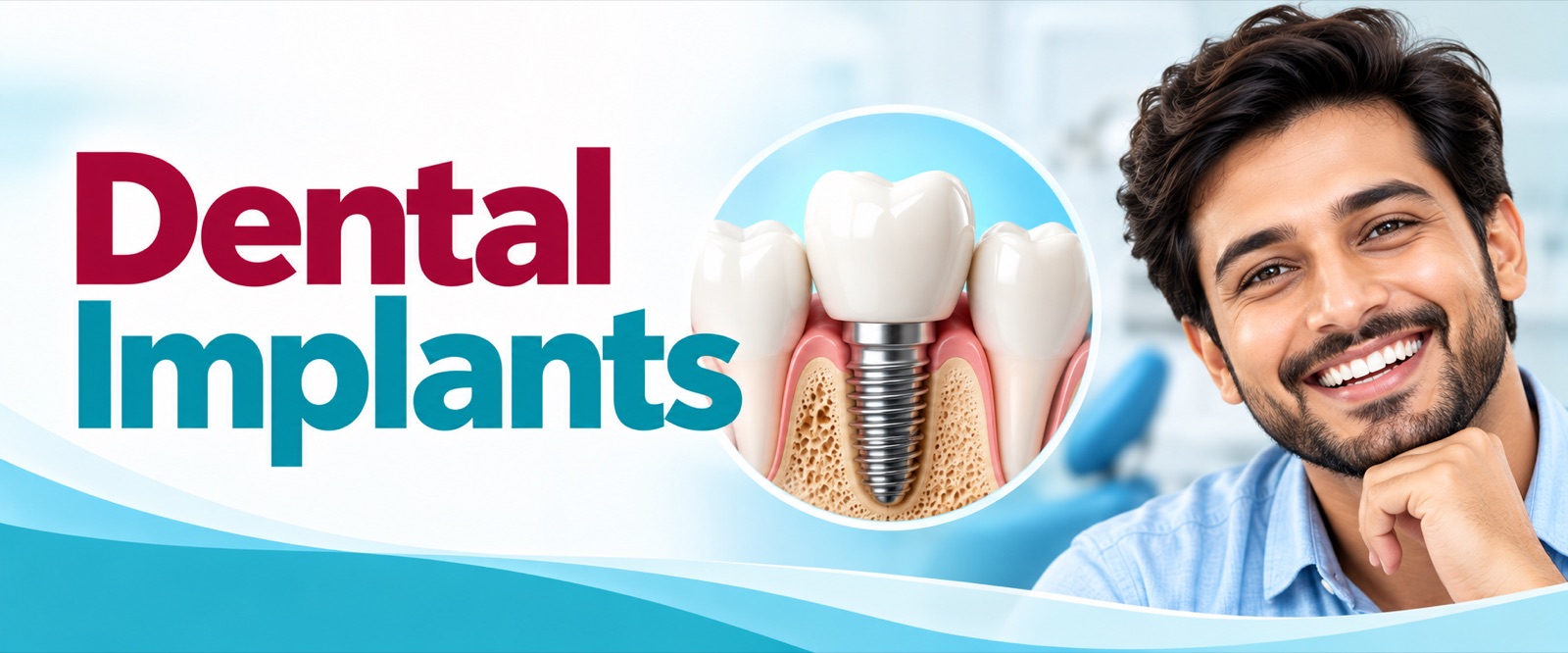
Smiling man beside a cut-away illustration of a dental implant anchored in the jawbone with a crown on top
Signature treatment

Dental implants in Goregaon West & Malad East

A dental implant is a small post, usually titanium, placed in the jawbone where a tooth has been lost, so that it works as a new root. When the bone has settled around it, a crown, bridge or denture is attached on top. It suits people missing one tooth, several teeth or most of them, provided their bone and gums are healthy enough.

★★★★★5.0 on Google from 124 patient reviews · Read what patients say

On this page

At a glance

Placed with the area numbedYou stay awake and feel pressure, not sharpness
Healing takes months, not daysOften 3 to 6 months before the final tooth
Two or more stagesThe post first, then the crown once the bone settles
Suitability is checked firstBone, gums and general health decide, not age alone
Understanding it

About this treatment

Picture a tooth lost two years ago. The gap looks like the only change, but underneath, the bone that once gripped the root has been thinning because nothing presses on it any more, and the teeth beside the gap have started to lean in. An implant is built to deal with that hidden part. The post stands in for the root, so the jaw gets some of the chewing load it was used to, and the neighbouring teeth are left alone instead of being filed down for a conventional bridge.

Dr. Mahesh Patel is a certified implantologist, and most of the real work in implant treatment happens before the post goes in. He studies your X-ray to judge how much bone there is, where the nerve runs in the lower jaw and, for upper back teeth, how near the sinus sits. He asks about diabetes, tobacco, blood pressure tablets and night-time grinding, since each one changes the plan. If the tooth is still in your mouth, he'll tell you whether a root canal could save it, and if a bridge or dentures would suit you better, he'll say that too.

People always want dates, so here is a rough calendar. Assessment and X-ray come in week one. If a damaged tooth has to come out first, expect a gap of some weeks before placement. After the post goes in, the bone usually needs three to six months, longer where a graft was done. Then the crown. If you have a wedding in three weeks, we can talk about how your smile looks on the day, and sometimes a temporary tooth is possible, but the implant itself will still need its months.

When implants are usually worth discussing

  • One missing tooth, and you don't want the neighbours filed down for a bridge
  • Several teeth gone and a partial denture that never sits still
  • A full denture that moves when you talk or eat
  • A tooth that can't be saved and would show when you smile
  • Chewing on one side only because the other has a gap
  • A long-standing gap with teeth leaning into it
Step by step

How implant treatment usually unfolds

First visit and X-ray

Dr. Mahesh looks at the gap, the gums and the teeth around it, then reads your X-ray for bone height and width. Bring any older X-rays and a list of your medicines. You'll talk through health conditions, tobacco and what you want from the tooth. Surgery isn't booked on day one unless you're ready and the picture is clear. That first visit is mostly looking and listening.

Preparing the site

If a damaged tooth is still present, it has to be removed and the socket given time to heal. Sometimes an implant can go in soon after removal, but that depends on infection and bone. Where bone is thin, a graft or sinus lift may be advised first, and gum disease is treated before any implant is placed. This stage can add weeks.

Placing the post

With the area numbed, a small opening is made in the gum and the post is set into the bone, followed by stitches. You'll feel pressure and vibration rather than sharpness. Say so if anything pinches and the anaesthetic can be topped up. Most people go home the same day, with soreness and swelling worst in the first couple of days.

Waiting while the bone settles

This is the long part, and it asks little of you except patience. Over a few months the bone grows against the surface of the post. You'll come back for reviews so the gum and the post can be checked, and a temporary tooth or denture may be possible if the gap shows. Smoking during this stretch is the habit most likely to cause trouble.

Attaching the tooth

Once the post is stable, a connector is fitted and impressions are taken so the crown or bridge can be made to match your bite and the shade of your other teeth. At the fitting the bite is checked and adjusted so nothing feels high or awkward. After that you're into a routine of cleaning and check-ups, which keeps the gum around it healthy.

Your choices

What can sit on implants

A single gap

One implant, one tooth

A single post carries a single crown, and the teeth on either side stay as they are. This is the simplest case, though the timeline still depends on your bone and gum health, and the crown is made once the post is stable.

A longer gap

Several implants, one bridge

Two or more posts can carry a bridge across a longer space, so you don't need one implant for every missing tooth. Dr. Mahesh works out from the X-ray how many posts your bone can reasonably support and where they should sit.

Most teeth lost

Fixed teeth for a whole jaw

A full set of fixed teeth held by roughly four to six implants is an option for people who have lost most of their teeth, if the bone allows it. It's a bigger decision, and it's discussed carefully before anything starts.

Thin or low bone

Building bone first

A bone graft, or a sinus lift for the upper back teeth, rebuilds the site before the post goes in. It lengthens the schedule, and not everyone needs it. Your X-ray shows whether you do, and Dr. Mahesh will point out why.

Implants aren't suitable for everyone, and not always straight away.Uncontrolled diabetes, untreated gum disease, heavy smoking or vaping and very little bone can each delay or rule out treatment. An examination shows which applies to you, and Dr. Mahesh will discuss alternatives if an implant isn't the right step.
Straight answers

Implant myths, sorted out

Myth

The body rejects implants, like a transplanted organ.

Fact

Fact: Not in that sense. When an implant fails, it's usually because the bone didn't bond to it, because of infection, or because of gum trouble around it. Smoking, poorly controlled diabetes and poor cleaning raise the risk, and most of these can be assessed before treatment.

Myth

Implants are only for older people.

Fact

Fact: Age isn't the deciding factor; healthy bone and gums are. Younger people may be asked to wait until the jaw has finished growing, while older people in good general health are often suitable. Dr. Mahesh decides after an examination and X-ray.

Myth

Once it's in, an implant needs no care.

Fact

Fact: The post can't decay, but the gum and bone around it can still become infected. Cleaning around it every day and keeping your check-ups is what protects it, and skipping both is the usual route to trouble later.

Looking after the implant, before and after

  • Bite on the gauze as shown and keep your tongue off the stitches on the first day.
  • Use a cold pack on the cheek in short spells during the first day.
  • Eat soft, lukewarm food for a few days and chew on the other side.
  • Take medicines exactly as prescribed, without adding antibiotics or painkillers of your own.
  • Rinse gently with warm salt water once Dr. Mahesh says you can.
  • Stay off cigarettes, bidis, tobacco and vaping while it heals, because they disturb the bone.
  • Brush twice a day, clean between teeth daily and keep every review.
  • Call us if the implant feels loose, the gum bleeds or swells, or you run a fever.
Visit us

Dental implant consultations near Unnat Nagar and Malad East

The Goregaon West clinic is on Navjyoti Society Road, off Mahatma Gandhi Road in Unnat Nagar 2, open Monday to Saturday from 10 AM to 4 PM. A first implant visit is mostly conversation and X-rays, so a daytime slot suits anyone with a free morning or afternoon. Implant treatment runs over several visits, so it helps to pick the clinic you can return to most easily. It's easy to reach from Goregaon East and Oshiwara.

The Malad East clinic is in Sunshine Co-op Housing Society on Subhash Lane, off B. L. Murarka Marg in Shivaji Nagar, open Monday to Saturday from 6 to 9 PM. Evenings suit people who work through the day, including those coming from Malad West or Kandivali. Walk-ins are welcome at both clinics, but a call or WhatsApp message first means no waiting. Bring old X-rays, your medicine list and any recent blood sugar reports, and say which clinic is easier for you.

Goregaon WestMain clinic

8/60, Navjyoti Society Rd, off Mahatma Gandhi Road, Unnat Nagar 2, Goregaon West, Mumbai 400104

Mon–Sat · 10:00 AM – 4:00 PM

Get directions →

Malad EastEvening clinic

Shop No. A/4, Sunshine Co-operative Housing Society, Subhash Lane, Shri. B. L. Murarka Marg, Shivaji Nagar, Malad East, Mumbai 400097

Mon–Sat · 6:00 PM – 9:00 PM

Get directions →
Good to know

Dental Implants: questions patients ask

Before you decide

Is a dental implant painful? +
Not during placement, because the area is numbed first. What you feel is pressure and some vibration rather than pain. Afterwards the site is usually sore and a little swollen for a few days, and most people manage with the painkillers they're prescribed. If anything sharp is felt in the chair, say so and the numbing can be topped up. If you're very nervous, mention it when you book so the sitting can be planned calmly.
What are the risks of a dental implant? +
Serious problems are uncommon when the case is chosen and planned well, but the risks are real: infection around the site, an implant that doesn't bond firmly to the bone and, in the lower jaw or upper back teeth, irritation of a nerve or the sinus. That's why your X-ray and medical history come first. A loose implant, bleeding or swollen gums, pus, fever or swollen glands in the neck mean you should call the clinic rather than wait.
Can I have an implant if I have diabetes or smoke? +
Often yes for diabetes, if your sugar is well controlled, and Dr. Mahesh may ask for recent blood reports first. Smoking and vaping are harder, since they slow healing and raise the chance of failure, so you'll usually be asked to stop around the time of treatment. Neither is an automatic no, and neither is ignored. It depends on the examination, your reports, and how ready you are to change a habit for a few months.
Why would a dentist suggest a bone graft or sinus lift before an implant? +
Because an implant needs enough healthy bone to hold it, and some jaws don't have that. Once a tooth has been missing for a while the bone can thin out, and above the upper back teeth the floor of the sinus can sit low. A graft adds bone to the site, and a sinus lift raises the sinus floor to make room. Both add healing time, and Dr. Mahesh will show you on the X-ray why he thinks it's needed.

Time and visits

How long does the whole implant process take? +
Often somewhere between three and six months from placing the post to fitting the final tooth, and longer if a graft or sinus lift is needed or a tooth must come out first. Most of that time is the bone settling, not you sitting in the chair. The appointments themselves are fairly few, but the exact timetable depends on your bone and how you heal. Dr. Mahesh can give you a realistic calendar after your assessment.
How soon after a tooth extraction can I get an implant? +
It depends. Sometimes the implant can go in at the time of removal, but more often the socket is left to heal for some weeks, or a few months, first. Infection, the amount of bone and the need for a graft all play a part, and the X-ray decides, not a fixed rule. What you shouldn't do is leave the gap for years, because bone can shrink and neighbouring teeth drift. Our tooth removal page covers the first step.
Can I get a tooth on the same day as the implant? +
Occasionally a temporary tooth can be fitted soon after the post is placed, usually at the front where a gap shows, but only if the implant is stable enough to take it. Don't count on it. Many people wait for the bone to settle, with either nothing in the gap or a temporary denture. If you have an event coming up, tell us the date at your first visit so the plan can be built around it where possible.

After the implant

How long does the soreness last after an implant, and will I need antibiotics? +
The worst of the soreness and swelling is usually in the first few days, with mild tenderness lasting up to about a week. A bone graft or sinus lift can take longer. Antibiotics and painkillers are sometimes prescribed, depending on the case, so follow the prescription and don't borrow tablets left over from an earlier illness. Pain that is growing after the first few days, pus, a fever or a loose implant should be checked.
How do I clean around an implant, and should I floss under the crown? +
Brush twice a day and clean between the teeth and around the implant crown every day, because the gum there can become infected just as it can around a natural tooth. Whether floss, a small interdental brush or a water jet suits you depends on the shape of your crown, so ask Dr. Mahesh to show you at the fitting. Early gum trouble is far easier to settle than bone loss that has been building for months.
Why do some implants fail or feel loose? +
The usual causes are infection or gum disease around the implant, poor bonding with the bone, smoking, uncontrolled diabetes, heavy grinding of the teeth, or too little bone to begin with. Sometimes it's the crown or its connecting screw that has loosened, not the implant itself. Either way, see a dentist soon. Don't try to tighten or glue anything yourself, and don't keep chewing on it, since waiting can turn a small fix into a larger one.
How long do dental implants last, and how often are check-ups needed? +
The post can last many years, often decades, when the gums stay healthy. The crown on top may wear or need replacing sooner, and no dentist can honestly promise a figure. Check-ups are how problems are caught early, and your dentist sets the interval according to your gums and how well you clean. Heavy tobacco use and night-time grinding make long life less likely, so they're worth mentioning.

Choosing and cost

Implant, bridge or denture: which is better for me? +
Each has a place. An implant doesn't need neighbouring teeth to be filed down and doesn't come out at night, but it needs surgery, healing time and enough bone. A bridge is quicker and needs no surgery, though it relies on grinding the teeth beside the gap. A denture is removable and needs no surgery, but may feel less steady. Dr. Mahesh explains the trade-offs for your mouth without pushing one option.
Is an implant better than saving the tooth with a root canal? +
If a tooth can be saved and restored, keeping it is generally the first thing to try, because an implant replaces a tooth that has already been lost. A root canal and crown can often rescue a tooth with deep decay or infection. If the tooth is too broken or the root is cracked, an implant becomes the sensible route. Bring your X-ray, since the answer comes from the picture and not from a general rule.
What decides the cost of a dental implant? +
Mainly the number of implants, whether a bone graft or sinus lift is needed, whether a tooth must be removed first, the type of crown or bridge, the implant system used and the scans required. Every mouth differs, so a figure only makes sense after an examination, and then you'll get a clear estimate. Message us on WhatsApp to arrange that assessment. It's also worth checking your health insurance policy, since many don't cover implants.
How do I choose an implant dentist, and which brand should I ask for? +
Ask who will do the surgery and the crown, what training they have, how the X-ray planning is done and who you see if something goes wrong later. Dr. Mahesh is a certified implantologist with over ten years in practice. The label on the implant matters less than the planning, the case selection and the follow-up, though it's reasonable to ask which system is being used and to have it explained to you.
Related treatments

You may also want to read

Missing a tooth? Let's see what your jaw can support.

Book a first assessment at Goregaon West or Malad East. Bring any old X-rays and your medicine list, and Dr. Mahesh will explain your options without pressure.

Call Now WhatsApp