2 clinics — Goregaon West & Malad East, Mumbai Open Mon–Sat
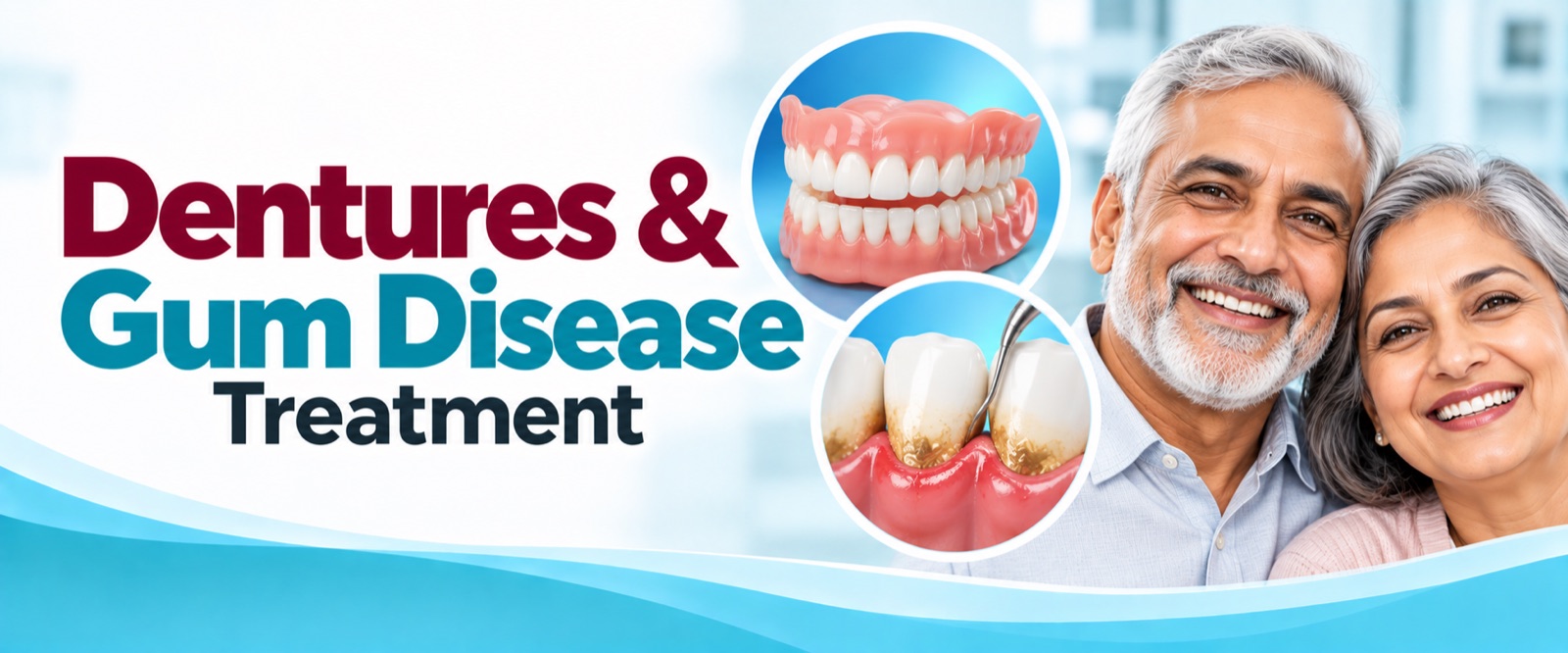
An older couple smiling together, beside illustrations of a full denture and of inflamed gums
Teeth and gums

Dentures and gum care for Goregaon West & Malad East

Dentures are removable replacement teeth, set in a gum-coloured base, that replace a few missing teeth or a whole arch. Gum care is the treatment of gum disease, the swelling and bleeding that, if ignored, can loosen teeth over time. This page is for anyone missing teeth, struggling with a denture that no longer fits, or noticing blood when they brush.

★★★★★5.0 on Google from 124 patient reviews · Read what patients say

On this page

At a glance

Rest on gums or clip to implantsDentures can be held by a few implants
Several short visitsImpressions, try-in, fitting, fine-tuning
Gum disease often doesn't hurtBleeding is the early signal
Reviews keep goingGums change, and so does the fit
Understanding it

About this treatment

Losing teeth rarely happens all at once. A molar goes, then another, and one day you realise you've been chewing on one side for years and avoiding certain foods without ever deciding to. Dentures replace what's missing with artificial teeth set in a base that matches your gums. A full denture covers a whole upper or lower arch; a partial one fills gaps and clips onto the teeth you still have. Both come out for cleaning, and both are made from impressions of your own mouth, which is why fit varies so much from person to person.

Gum care shares this page because gum disease is often how teeth are lost in the first place. Plaque left along the gumline irritates the gum, which swells and bleeds, and over time the bone around the root starts to dissolve. That's when a solid tooth begins to wobble. The advanced form is sometimes called pyorrhoea, an older term for the same condition as periodontitis. Early disease usually doesn't hurt, so plenty of people assume blood in the sink is normal. It isn't, which is why a gum check is part of any denture plan.

What happens next depends on the stage. Early inflammation settles with a thorough clean and better home care, the routine visit described on our teeth cleaning and polishing page. Once the problem has moved below the gumline, a deeper cleaning of the root surfaces is needed, and bone already lost isn't regrown by cleaning alone. Dentures aren't the only way to replace teeth, either. A bridge or implants may suit you, and a tooth beyond saving needs extraction first. So Dr. Mahesh looks first and recommends second, whichever route you end up on.

You might be in the right place if

  • You've lost several teeth and chewing has become a chore
  • Your denture slips when you speak or laugh, or clicks as you eat
  • One spot under the denture keeps getting sore
  • Your gums bleed when you brush, floss or bite into an apple
  • Breath smells even after brushing, or there's a stubborn bad taste
  • Gums look puffy or dark red, or seem to be pulling away
  • An adult tooth feels loose or has shifted position
Step by step

How denture treatment usually goes

Gums first, then the plan

Dr. Mahesh examines your mouth, asks about your general health and takes X-rays where needed. If your gums are inflamed they're treated before impressions are made, because a denture built over unhealthy gums soon stops fitting as they shrink. Any tooth that has to come out is planned in at this stage too, so nothing surprises you later. Questions are welcome.

Impressions

Moulds of your gums and any remaining teeth are taken with a soft material in a tray. It feels cold and a little bulky for a minute or two. Breathe through your nose, and tell us if you tend to gag, because small changes in how the tray is placed can help. The laboratory works from these shapes to make your denture.

Bite and tooth selection

The way your jaws meet is recorded, and the size, shape and shade of the teeth are chosen with you. This decides if you'll look like yourself or like someone wearing teeth, so say how much of them you want to show when you smile. Old photographs help if you have any, since they show how your own teeth looked.

Try-in

A trial denture with the teeth set in wax goes into your mouth so you can check the look, your speech and the bite before it's finished. Changes are easy now and hard later. Bring someone whose opinion you trust, and read a few sentences aloud while it's in, because speech is where fit problems show first. Tell us what you'd change.

Fitting and fine-tuning

The finished denture is fitted and checked for pressure spots. It will feel bulky at first, with extra saliva for a few days. Dr. Mahesh shows you how to put it in and take it out. Sore patches in the early weeks are normal and the dentist corrects them, so please don't file them yourself. Most people need several short adjustment visits.

Your choices

Types of denture and gum treatment

Whole upper or lower arch

Full dentures

Replace every tooth on one jaw. An upper denture is held partly by suction against the palate, which is why a lower one, with less surface area and a tongue that moves about, is usually the harder one to keep steady.

Some natural teeth remain

Partial dentures

They clip onto healthy teeth to fill the gaps, without those teeth being cut down, and come out for cleaning. They suit people who still have healthy teeth worth keeping. Lighter flexible versions exist; Dr. Mahesh can tell you whether one would suit your mouth and bite.

Clip onto implants

Implant-supported dentures

A denture that locks onto a few dental implants rather than resting on the gums alone. It's steadier, but it needs enough bone, surgery and healing time, so it isn't for everyone. It's often discussed for lower dentures that won't stay put, and Dr. Mahesh will check what's realistic.

Deep cleaning below the gumline

Gum disease treatment

Tartar is removed from beneath the gum and the root surfaces are smoothed so the tissue can settle back. It's usually done under local anaesthetic, sometimes over more than one visit, with a review afterwards to see how the gums responded.

Don't wait for gum pain.Gum disease usually doesn't hurt until it's well advanced, so bleeding, a lingering bad taste or a wobbly tooth is the signal to book. See a dentist or doctor urgently for a swollen face with fever, or bleeding that won't stop.
Straight answers

Myths about gums and dentures

Myth

Bleeding gums just mean you're brushing too hard.

Fact

Fact: Bleeding usually comes from plaque-driven inflammation at the gumline, so brushing less makes it worse. Clean gently but thoroughly, and if it hasn't improved in a couple of weeks, have it checked, since tartar under the gum needs a dentist to remove it.

Myth

Loose teeth will tighten up by themselves.

Fact

Fact: Not reliably. Adult teeth loosen when the bone and tissue around them are damaged, and wiggling or home tricks won't rebuild that. How early you're assessed decides whether a loose tooth can be kept, so book a visit rather than waiting.

Myth

Once you have dentures, check-ups are over.

Fact

Fact: Gums and jawbone keep changing, so a well-fitting denture can loosen. Your gums, tongue and palate still need daily cleaning, and reviews let the dentist spot sore patches, poor fit or gum trouble early.

Looking after dentures and gums

  • Rinse dentures after meals and brush them daily with a soft brush and denture cleaner or mild soap, over a basin of water in case they slip. Ordinary toothpaste is often too abrasive.
  • Leave them out overnight unless Dr. Mahesh has told you otherwise, kept in water or a cleaning solution.
  • Brush your gums, tongue and palate daily with a soft brush, even with no natural teeth left.
  • Don't bend clasps or trim the base yourself. Sore spots are a quick job for the dentist.
  • In the early weeks, cut food small, chew on both sides together and start with soft meals such as khichdi, idli or dal-rice.
  • For your own teeth, use a soft brush at the gumline twice daily and floss or interdental brushes once a day.
  • Tobacco, paan and gutkha slow gum healing, and diabetes makes gum disease harder to settle, so tell Dr. Mahesh about both.
  • Keep up routine scaling and polishing visits between gum treatments.
Visit us

Dentures and gum care near Goregaon West and Malad East

Denture work takes several short visits, for impressions, the try-in and the fitting, so the Goregaon West clinic's daytime hours suit anyone retired, working from home or able to slip out mid-morning. It's at 8/60, Navjyoti Society Road, off Mahatma Gandhi Road, Unnat Nagar 2, open Monday to Saturday, 10 AM to 4 PM, and easy to reach from Goregaon East, Oshiwara and Bangur Nagar. Bring a family member to the try-in.

The Malad East clinic, open Monday to Saturday from 6 PM to 9 PM at Shop No. A/4, Sunshine Co-op Housing Society, Subhash Lane, B. L. Murarka Marg, Shivaji Nagar, works well for gum treatment visits if you're busy during the day. Bring your current denture, even a cracked one, plus any old X-rays and a list of your tablets, especially blood thinners or diabetes medicines. Call or message us on WhatsApp to book; walk-ins are welcome, but a booked slot means less waiting.

Goregaon WestMain clinic

8/60, Navjyoti Society Rd, off Mahatma Gandhi Road, Unnat Nagar 2, Goregaon West, Mumbai 400104

Mon–Sat · 10:00 AM – 4:00 PM

Get directions →

Malad EastEvening clinic

Shop No. A/4, Sunshine Co-operative Housing Society, Subhash Lane, Shri. B. L. Murarka Marg, Shivaji Nagar, Malad East, Mumbai 400097

Mon–Sat · 6:00 PM – 9:00 PM

Get directions →
Good to know

Dentures & Gum Care: questions patients ask

Getting your dentures

How long does it take to get used to new dentures? +
Most people need a few weeks, and some take a couple of months. Everything feels bulky at first, you'll make extra saliva, and certain words come out oddly until your tongue learns the new shape. Start with soft food in small pieces, chew on both sides at once and read aloud at home. Roti, apples and anything sticky can wait. If one spot rubs, don't wait it out, because a quick adjustment usually solves it.
What is the difference between a full and a partial denture? +
A full denture replaces every tooth on the upper or lower jaw, while a partial denture fills gaps between teeth you still have. A partial one usually clips onto some of those natural teeth for grip, and a full one depends on suction and the shape of your gums. Either is made from impressions of your own mouth. Dr. Mahesh will check how healthy your remaining teeth are before deciding which will serve you better.
Should a denture hold without any adhesive? +
A well-fitting denture should feel reasonably secure without adhesive, particularly an upper one. Adhesive is an optional extra that some people like for confidence, used as the product instructs. What it can't do is rescue a denture that has stopped fitting. Lower full dentures are the hardest to keep steady and may feel loose even when they're well made.
Will my final denture fit better than an immediate one? +
Often, yes. An immediate denture goes in on the day teeth are removed, and as the gums heal and shrink over the next months it usually needs relining or remaking. A denture made after healing is generally a closer fit because it follows the settled shape of your mouth. Think of the immediate one as a first stage that spares you going without teeth. Dr. Mahesh will explain the sequence for your case.

Wearing and looking after dentures

How long do dentures last? +
Often somewhere around five to ten years, though it varies a lot from person to person. The teeth wear, and more importantly your gums and jawbone slowly change shape, so a denture that fitted well can loosen. Relining or adjusting every year or two is common. A sudden change in fit, a crack or a sore patch that won't settle is a reason to book a check, not something to put up with.
Why has my denture become loose? +
Usually because your gums and jawbone have changed shape since it was made. After teeth are lost the ridge slowly shrinks, so the denture stops sitting snugly, and a cracked base or worn teeth can add to it. Adhesive may tide you over but doesn't cure the problem. Don't bend the clasps or file the base yourself, as that can make things worse. Dr. Mahesh can tell whether it needs relining, adjusting or remaking.
Why do my gums hurt under my denture? +
A sore patch usually means a pressure point, where one part of the denture presses harder than the rest. A new denture often needs a few adjustments before everything is even. Warm salt-water rinses and softer food can ease things in the meantime, but the dentist should reduce the spot, not you. Come in promptly if the gum is red all over, bleeding or smells bad, or hasn't settled within a couple of weeks.
Should I sleep with my dentures in? +
Usually not. Gums get tired of constant pressure, so a few hours without the denture each day, most simply overnight, lets them rest. Keep it in water or a denture-cleaning solution rather than dry. There are exceptions: after an immediate denture goes in, your dentist may ask you to keep it in for the first day or so. Follow the instructions you're given for your own case.
I think I swallowed my partial denture. What should I do? +
Get medical help straight away; don't wait to see whether it passes. A swallowed or inhaled denture can lodge in the throat, windpipe or gut, and it needs to be assessed at a hospital. If you're coughing, choking, struggling to breathe or swallow, or have chest or stomach pain, treat it as an emergency. Once you're safe, come and see us and we can talk about a replacement.

Gum disease and bleeding gums

How long will it take for my gums to stop bleeding once I clean properly? +
Often within a couple of weeks of gentle, consistent cleaning at the gumline, though it varies. Use a soft brush angled where tooth meets gum, and clean between teeth daily. If gums are still bleeding after two or three weeks, there's probably hardened tartar under the gum that home care can't reach, and it needs a professional clean. Heavy bleeding, or bleeding that won't stop, needs to be seen sooner.
Is gum disease curable? +
The early stage, gingivitis, can be reversed completely with a professional clean and better home care. The later stage, periodontitis, which you may hear called pyorrhoea, can usually be controlled but not cured. Treatment removes the tartar and bacteria so the gums settle and the damage stops spreading, but bone already lost doesn't regrow from cleaning alone. Regular check-ups and daily cleaning keep it under control, and losing teeth isn't inevitable.
Can loose teeth from gum disease tighten up again? +
Sometimes a little, but not reliably. Teeth loosen when gum disease eats away the bone and tissue that hold them. If the looseness is mild and the gums are badly swollen, it can improve once the inflammation is treated; with a lot of bone gone, it may not. A tooth can also feel slightly looser for a while after a deep clean, until the gums firm up. Don't wiggle it or try to fix it yourself, and book soon.
Is gum disease more of a worry in pregnancy or with diabetes? +
Yes, both make gum trouble more likely, so tell the dentist. Hormonal changes in pregnancy can leave gums swollen and quicker to bleed, and diabetes can make gum disease more likely and slower to settle. Neither means you'll certainly get it. Gentle, thorough cleaning at home and a check-up are sensible, and Dr. Mahesh should know about your condition and medicines before any treatment.

Other options and cost

What are my options if I don't want dentures? +
For a single missing tooth or a short gap with healthy neighbours, a bridge is one option, and implants are another where there's enough bone. Each has trade-offs: a bridge means shaping neighbouring teeth, an implant means surgery and months of healing, and a denture is removable but needs no surgery. Our pages on crowns and bridges and dental implants explain them, and Dr. Mahesh will say which are realistic for your mouth.
What decides the cost of dentures or gum treatment? +
The type and size of the denture, how many teeth are being replaced, the materials, and how many visits it takes to get the fit right. For gum treatment, how deep the problem goes decides the number of visits. Any extractions or other treatment needed first change the plan too. We can't give a fair figure without examining you, so please call or message us on WhatsApp and we'll arrange an assessment.
Related treatments

You may also want to read

Missing teeth or bleeding gums? Let Dr. Mahesh take a look.

He will explain what he finds and what each option involves, without pressure. Call or message us to book a visit at Goregaon West or Malad East.

Call Now WhatsApp